
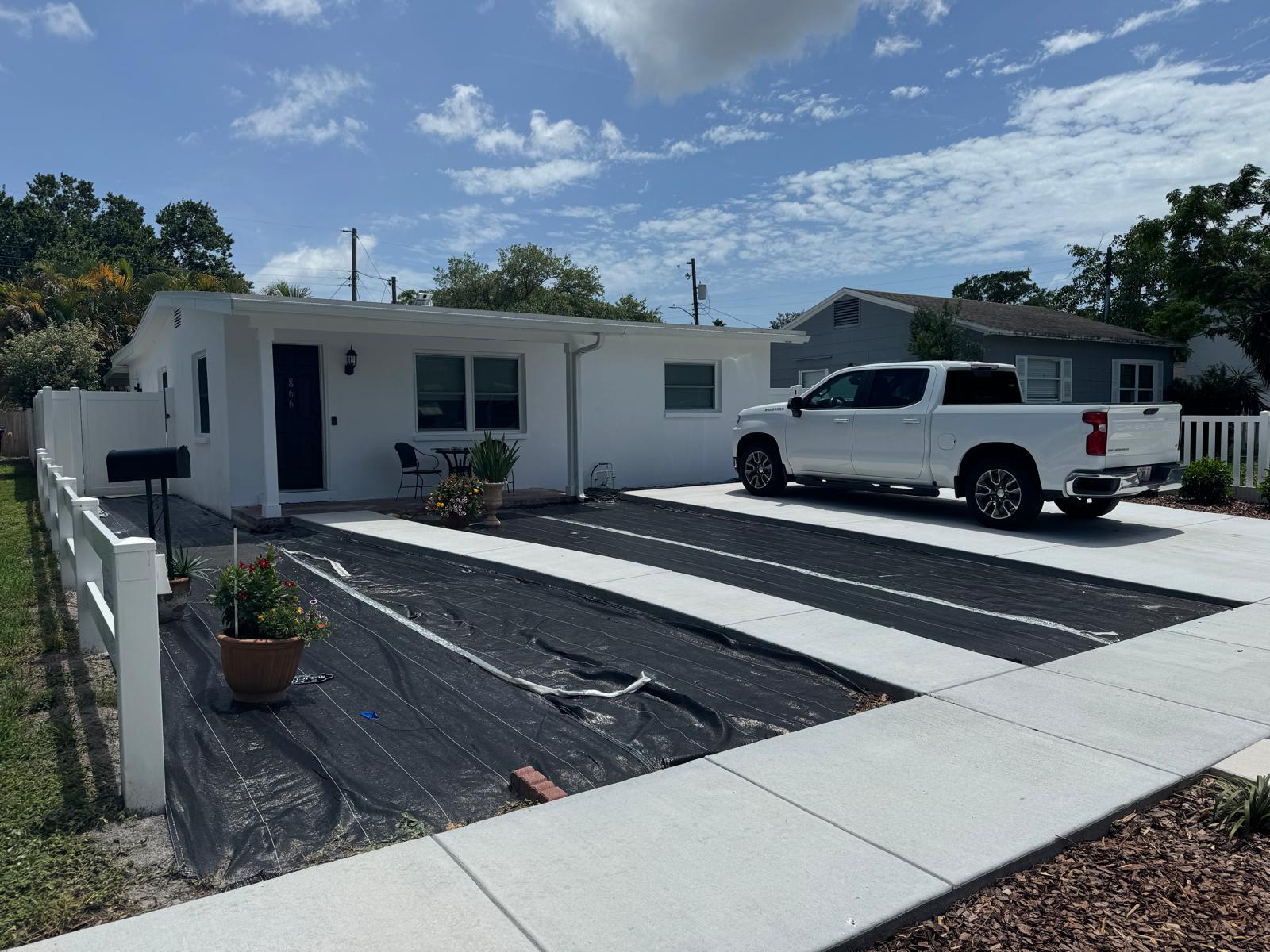
Florida makes exterior painting deceptively difficult. A fresh coat can look perfect when the job is finished, then months of intense sun, humidity, rain, and moisture exposure begin testing the coating.
If you’re searching for the best paint for Florida humidity exterior projects, the answer isn’t simply one brand or one color. The right exterior coating needs to handle moisture while remaining flexible enough for Florida’s temperature changes, resist fading from strong UV exposure, and provide protection against mildew and other common problems.
For homeowners in St. Petersburg, there’s another consideration: coastal exposure. Homes closer to the water can also deal with salt carried through the air, while shaded areas may stay damp longer after rain. That means choosing the paint is only part of the equation. Proper cleaning, repairs, priming, and application conditions matter just as much.
Here’s what to look for before you put a new finish on your home’s exterior.
Best Paint for Florida Humidity Exterior: What Should You Look For?
The first thing to understand is that “humidity-resistant paint” isn’t necessarily a special category of paint sitting on a store shelf. You’re looking for an exterior coating with properties that make sense for Florida’s environment.
100% Acrylic Exterior Paint
For many residential exterior projects, a quality acrylic latex coating is a strong starting point.
Acrylic coatings can provide the flexibility and adhesion needed for exterior surfaces that experience repeated heat, cooling, rain, and moisture exposure. The specific product matters, though. Not every acrylic paint is formulated to the same performance standard.
Look for an exterior product that specifically identifies features such as:
- Mildew-resistant coating
- UV or fade resistance
- Resistance to peeling and blistering
- Good adhesion
- Exterior-rated durability
- Resistance to dirt pickup
These characteristics are more meaningful than simply choosing the most expensive gallon of paint.
Elastomeric Coatings for Certain Stucco Homes
Elastomeric coatings are another option worth discussing, particularly for some stucco exteriors.
Unlike conventional paint, elastomeric coatings are designed to form a more flexible, thicker film. That flexibility can be useful when dealing with certain hairline cracks and masonry surfaces.
However, elastomeric isn’t automatically the best choice for every St. Petersburg home.
Stucco needs to be evaluated first. Existing coatings, moisture conditions, cracks, repairs, and the condition of the substrate can all influence whether an elastomeric system is appropriate.
A contractor shouldn’t recommend it simply because the word “waterproof” sounds appealing.
What Makes Florida Humidity Hard on Exterior Paint?
Humidity itself isn’t the only problem.
St. Petersburg homes experience a combination of environmental stresses that can accelerate exterior paint deterioration.
Moisture
High humidity can keep surfaces damp, especially on shaded sides of a home. If the substrate isn’t properly cleaned and dried before painting, adhesion problems can develop.
Moisture can also become trapped beneath coatings when existing problems aren’t addressed before painting.
Intense Sun
Florida’s sunlight is another major factor.
UV exposure can cause exterior colors to fade and coatings to chalk over time. Darker colors can be particularly demanding because they absorb more heat and may experience greater thermal stress.
This is why fade resistance and color selection deserve attention when repainting a St. Petersburg home.
Rain
Heavy rain repeatedly exposes exterior surfaces to water.
A quality exterior coating should be able to withstand normal weather exposure, but paint can’t compensate for underlying water problems. Gutters, flashing, roof details, window areas, caulking, and drainage should be addressed if they are allowing water to reach the wall system.
Salt Air
If you’re near the Gulf or other coastal areas, airborne salt adds another layer of exposure.
Salt deposits can accumulate on exterior surfaces. This is one reason proper washing before repainting matters so much for coastal homes.
Painting over a dirty surface doesn’t create a clean substrate. It simply puts a new coating over the contamination.
Three Premium Exterior Paint Options Worth Considering
There isn’t one universal winner, but several premium products have characteristics that make them worth considering for Florida homes.
Sherwin-Williams Emerald Exterior
Sherwin-Williams describes Emerald Exterior Acrylic Latex as a premium coating with resistance to blistering, peeling, fading, mold, mildew, and dirt pickup. The product is also self-priming and designed for exterior use.
For a St. Petersburg homeowner, those properties address several of the problems that matter most: moisture exposure, strong sunlight, and long-term exterior durability.
It’s a premium option, so the material cost can be higher than basic exterior paint. But when the project is being done properly, the goal isn’t simply to buy inexpensive paint. The goal is to create a coating system that performs for years.
Sherwin-Williams Duration Exterior
Duration Exterior is another premium acrylic option. Sherwin-Williams states that it uses PermaLast technology and advanced acrylic copolymers, provides a mildew-resistant coating, and is self-priming.
One of its practical advantages is that Sherwin-Williams specifies one-coat performance for repaints and two coats for new work under its stated application conditions. That doesn’t mean every St. Petersburg repaint automatically needs only one coat. Surface condition, color changes, repairs, and the contractor’s application process still matter.
Benjamin Moore Aura Exterior
Benjamin Moore positions Aura Exterior as its ultra-premium exterior paint, with technology focused on color retention, fade resistance, and durability.
The manufacturer states that Aura Exterior uses a 100% acrylic resin, offers UV and fade resistance, and has a mildew-resistant coating. It also describes the coating as breathable, allowing internal moisture to escape and helping minimize potential blistering and peeling.
That’s particularly relevant in a humid environment where managing moisture is important.
Aura Exterior is available in several sheens, including flat, low-lustre, satin, and soft gloss, so homeowners aren’t limited to one finish.
Is Satin the Best Exterior Finish for a St. Petersburg Home?
Not necessarily.
A common piece of advice is that homeowners should always use satin or semi-gloss exterior paint because flat finishes supposedly trap moisture. That’s too simplistic.
The appropriate sheen depends on the surface, appearance you’re trying to achieve, and the manufacturer’s recommendations.
For example, Aura Exterior is offered in flat as well as low-lustre, satin, and soft-gloss finishes.
A flatter finish can be useful when you want to minimize the appearance of imperfections on stucco or other textured surfaces. Higher-sheen finishes can be easier to clean and may be appropriate for trim and certain high-contact areas.
The important thing is to choose a finish appropriate for the substrate rather than assuming one sheen works everywhere.
Paint Quality Can’t Fix Poor Surface Preparation
This is probably the most important lesson for any homeowner hiring a painter in St. Petersburg.
You can buy one of the best exterior paints available and still end up with peeling paint if the surface underneath isn’t properly prepared.
Before painting, the contractor may need to:
- Pressure wash the exterior
- Remove dirt, mildew, and salt deposits
- Scrape loose or peeling paint
- Sand damaged areas
- Repair cracks
- Replace deteriorated wood
- Prime exposed substrate
- Re-caulk appropriate joints
- Allow surfaces to dry properly
The exact preparation depends on the condition of the home.
For example, painting over chalking paint without addressing the surface can create adhesion problems. Likewise, painting over active moisture intrusion doesn’t solve the underlying problem.
A quality contractor should be able to explain what preparation your home actually needs rather than simply quoting a price per square foot.
When Should You Paint a Home in St. Petersburg?
Timing matters more in Florida than many homeowners realize.
A painting contractor needs to consider:
- Rain in the forecast
- Surface temperature
- Humidity
- Direct sunlight
- Dew
- Drying and recoat times
- The manufacturer’s application requirements
A hot, sunny day isn’t automatically a perfect painting day.
Direct sunlight can heat a surface substantially above the surrounding air temperature, while high humidity can affect drying. A professional painter should follow the product’s technical data rather than relying on a generic rule such as “Florida is warm, so we can paint anytime.”
The best approach is to monitor actual site conditions and follow the paint manufacturer’s application requirements.
How to Choose the Right Paint for Your Home
Instead of asking, “What’s the best exterior paint in Florida?” ask five more useful questions.
What is my exterior made of?
Stucco, wood, fiber cement, masonry, and vinyl can have different coating requirements.
How much sun does the house receive?
A heavily sun-exposed wall may benefit from a coating with strong fade and UV resistance.
Is the home exposed to coastal air?
Homes closer to the coast may need more frequent cleaning and careful surface preparation because of salt exposure.
Does the surface have cracks or moisture problems?
Those issues should be addressed before selecting the final coating system.
What does the manufacturer recommend?
The technical data sheet is more reliable than a generic internet recommendation. It tells you how the product is designed to be used, including compatible surfaces and application conditions.
Don’t Choose Paint Based on Price Alone
It’s tempting to compare paint cans by their price per gallon.
But that’s only one part of the project.
A lower-priced coating may not provide the same combination of durability, hide, color retention, and resistance to weathering as a premium product. At the same time, the most expensive paint isn’t automatically the best choice for every surface.
Think about the entire system:
Surface condition + preparation + primer when needed + paint quality + application + maintenance
All six affect the finished result.
If preparation is poor, upgrading from a good paint to a premium paint won’t magically solve the problem.
How Long Should Exterior Paint Last in Florida?
There’s no honest one-number answer.
Paint lifespan depends on the product, substrate, preparation, number of coats, color, sun exposure, moisture, proximity to salt air, and ongoing maintenance.
A home that receives strong afternoon sun and coastal exposure may show fading or wear sooner than a more protected property.
Instead of waiting until paint is severely peeling, homeowners should watch for early warning signs:
- Fading
- Chalking
- Hairline cracking
- Peeling
- Blistering
- Mildew growth
- Exposed substrate
- Failed caulking
Catching these problems early can make the next repaint easier and may prevent minor surface issues from becoming larger repairs.
Frequently Asked Questions
What is the best paint for Florida humidity exterior projects?
For many residential projects, a high-quality 100% acrylic exterior coating is an excellent choice. Premium products such as Sherwin-Williams Emerald Exterior, Sherwin-Williams Duration Exterior, and Benjamin Moore Aura Exterior offer features designed for demanding exterior conditions, including mildew resistance and resistance to weather-related deterioration.
Is elastomeric paint better for Florida?
Elastomeric coatings can be useful on certain stucco and masonry surfaces, particularly where flexibility and crack-bridging characteristics are appropriate. However, they aren’t automatically better for every home. The substrate and existing coating should be evaluated before choosing an elastomeric system.
What paint finish is best for Florida exteriors?
There isn’t one universally correct sheen. Flat, low-lustre, satin, and gloss finishes can all have appropriate applications depending on the surface and desired appearance. Follow the manufacturer’s recommendations for the specific product and substrate.
Does humidity cause exterior paint to peel?
Humidity can contribute to paint problems, particularly when moisture is present in or behind the coating, but peeling can have several causes. Poor surface preparation, existing coating failure, moisture intrusion, incompatible coatings, and improper application conditions can all contribute.
Is expensive exterior paint worth it in Florida?
Premium paint can be worthwhile when paired with proper preparation and application. The value comes from the complete coating system—not simply paying more for a paint can.
Final Thoughts: The Paint Is Only Half the Job
If you’re looking for the best paint for Florida humidity exterior projects, don’t start by asking which brand wins.
Start with your house.
A St. Petersburg home needs a coating system suited to its actual exterior surface and exposure. That means evaluating the substrate, cleaning away contaminants, correcting surface problems, choosing an appropriate primer when needed, selecting a durable exterior coating, and applying it under suitable conditions.
Sherwin-Williams Emerald, Sherwin-Williams Duration, and Benjamin Moore Aura Exterior are all premium products with documented performance characteristics that make them reasonable options to consider.
But even the best paint can’t compensate for poor preparation.
For a St. Petersburg homeowner, the smartest investment is usually not simply buying the most expensive paint available. It’s choosing the right coating for the surface and climate—and making sure the entire preparation and application process is done correctly.
That’s what gives an exterior paint job the best chance of standing up to Florida’s humidity, sunlight, rain, and coastal conditions year after year.